-24125.png)

Flops, Oddities and Cult Classics: The Weird History Behind Your MacBook
Apple likes to be remembered for its hits. The original iMac. The MacBook Air sliding out of an envelope. But the road to the sleek aluminium slab on your desk is littered with machines that were too heavy, too expensive, too weird — or occasionally, so odd they became legends.
Here's a tour through Mac history's strangest chapters, and what they tell you about the MacBooks actually worth owning today.
The Macintosh Portable (1989): a "laptop" you could barely lift
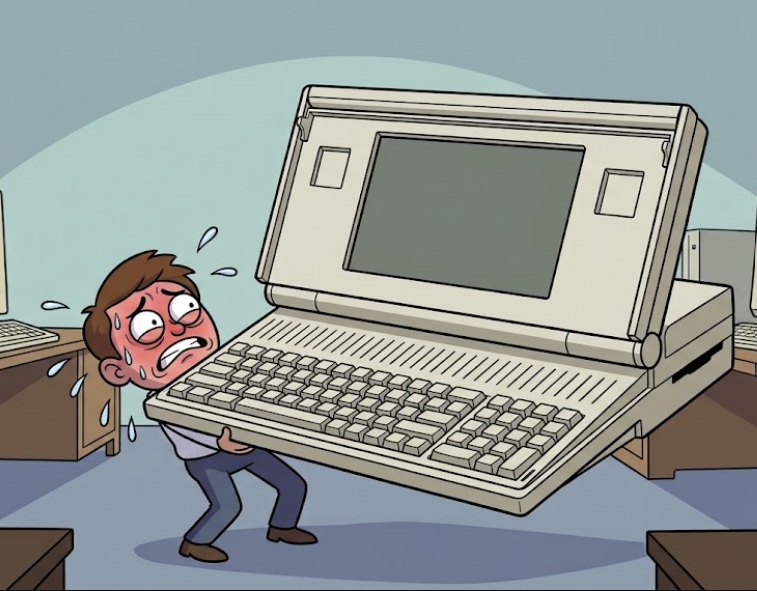
Apple's first attempt at a portable Mac weighed around 7kg — roughly five modern MacBook Airs stacked on top of each other — and cost the equivalent of a decent used car. It had a lead-acid battery, like the one in that car, and a design quirk for the ages: if the battery was completely dead, the machine sometimes wouldn't switch on even when plugged into the wall.
It flopped, magnificently. But it forced Apple to learn the lesson that would eventually define the company: portability isn't a feature, it's the whole point. Two years later the PowerBook arrived, invented the palm-rest-and-trackball layout every laptop still uses today, and the modern notebook was born.
The Twentieth Anniversary Mac (1997): a £5,000 birthday card to itself
To celebrate turning twenty, Apple released a futuristic, flat-screened machine with a Bose sound system, leather palm rests and — in the early days — white-glove delivery where someone would set it up for you. The price was astronomical, the specs were ordinary, and it landed just as Apple was nearly going bankrupt.
Within a year the price had been slashed to a fraction of the original, an early demonstration of a rule that still holds: the person who pays launch price for shiny new Apple hardware is doing a favour for the person who buys it later.
The Power Mac G4 Cube (2000): the flop that ended up in a museum
The Cube is the strangest entry on this list because it failed and succeeded at the same time. An eight-inch cube of computer suspended in clear acrylic, silent, fanless, and beautiful — it was also more expensive than the more powerful tower next to it in the shop, and buyers noticed. Apple quietly "suspended" production within a year.
And yet the Cube never really died. It sits in the Museum of Modern Art's collection in New York, collectors still hunt for them, and you can see its DNA in the Mac Mini and Mac Studio sitting on desks today. Sometimes a flop is just a good idea arriving before its audience.
The butterfly keyboard era (2015–2019): the most controversial MacBook ever made
If you've ever wondered why people ask "which MacBook years should I avoid?", this is the answer they're usually looking for. In pursuit of thinness, Apple redesigned the MacBook keyboard around a "butterfly" mechanism so shallow that a single crumb could disable a key. Repair programmes followed, then lawsuits, then — in 2020 — a quiet return to the older, reliable "scissor" design.
The whole saga produced one genuinely useful piece of buying knowledge: MacBooks from 2020 onwards use the fixed keyboard, which is one reason those model years are the sweet spot on the used and refurbished market.
The one-port MacBook (2015): too clever for its own good
The 12-inch MacBook was, in classic Apple fashion, a preview of the future sold at a premium in the present. It was impossibly thin and light, and it had exactly one port — for charging, data, everything. It was also slow, and it carried the butterfly keyboard. Apple discontinued it in 2019, then spent the next few years putting its best ideas (fanless design, extreme portability) into a machine that actually delivered on them.
Where all those weird experiments ended up: Apple silicon
Every oddity above was Apple testing an obsession — portability, silence, thinness, design — before the technology could support it. In 2020, the technology finally caught up. Apple ditched Intel and put its own M1 chip into the MacBook Air: fanless like the Cube dreamed of being, light like the 12-inch MacBook promised, with battery life the Macintosh Portable's lead-acid brick could never have imagined.
That's why M-series MacBooks have aged so unusually well, and why an M1 or M2 MacBook bought today — several years after launch — still feels fast for everyday work. In thirty-odd years of Mac history, they're the first machines where buying a few years behind the curve costs you almost nothing in real-world performance.
The cheerful moral of the story
Mac history has two kinds of old machines: the cult classics you frame on a wall, and the quietly brilliant ones you can still happily use every day. The trick — and the money-saving opportunity — is knowing which is which.
A refurbished M-series MacBook belongs firmly in the second camp: modern keyboard, modern chip, none of the era-defining mistakes, and a price that reflects someone else having paid the "new Apple hardware" premium the Twentieth Anniversary Mac made famous.
The weird stuff belongs in museums. The good stuff belongs on your desk.
Curious what a few-years-old MacBook can really do? Browse our refurbished MacBook range — every model tested, graded and backed by warranty, with none of them weighing 7kg.